

Market Views, Macro | Weak labour market growth
The labour market in Oslo has been weaker than the national average in recent years, and subdued employment growth is likely to remain a feature of the economy over the next few years. Over the next 10 to 20 years, growth in Oslo's labour force is also expected to be significantly lower than in the decades preceding the pandemic.
Low Employment Growth in the Years Ahead
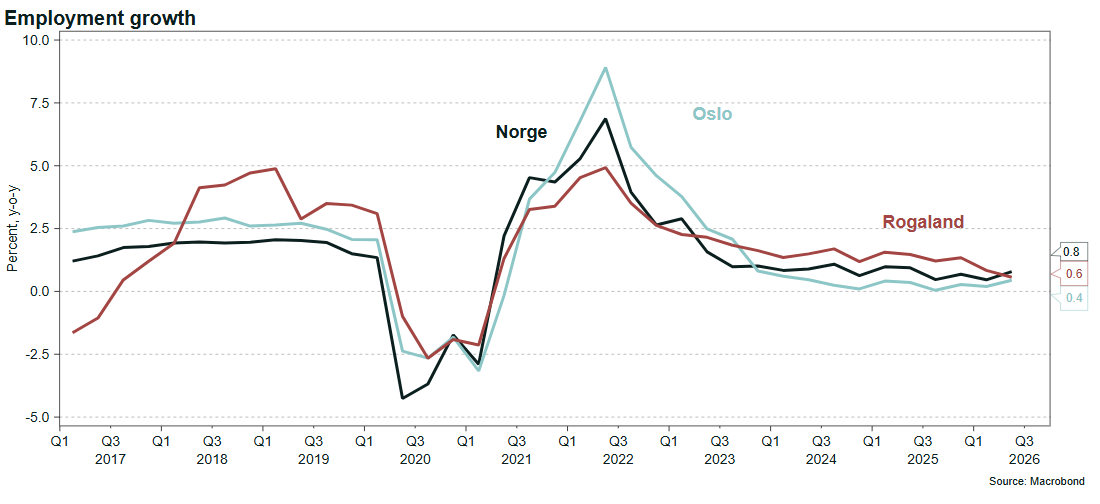
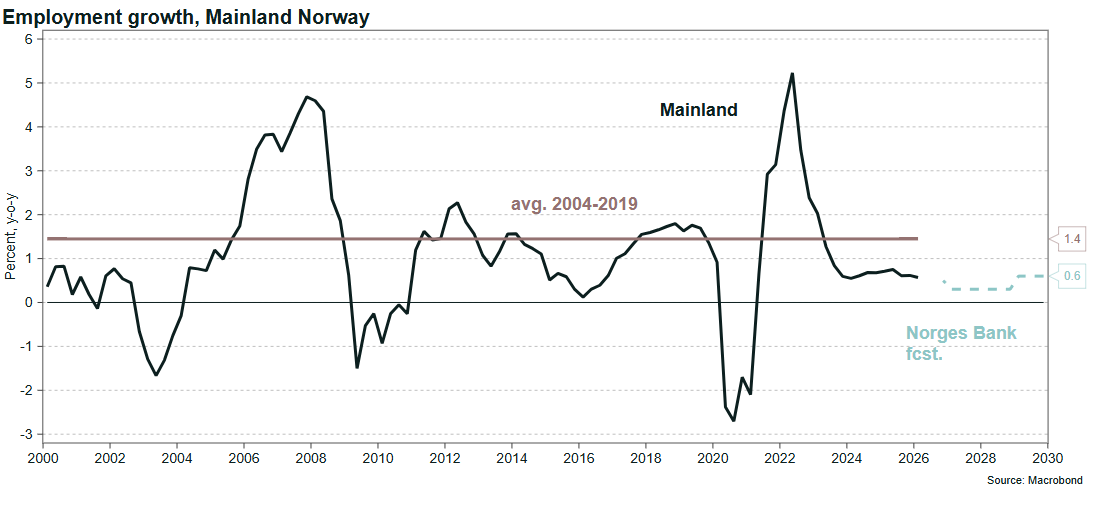
Employment growth in mainland Norway has been relatively weak over the past couple of years. Having averaged 1.4 percent per annum between 2004 and 2019, nationwide employment growth has slowed to around 0.6 percent per year since 2024. Since 2024, employment growth in Oslo has lagged the national average, while the oil-driven regions of Western Norway have recorded stronger growth. In recent quarters, however, employment growth has also begun to moderate in Western Norway.
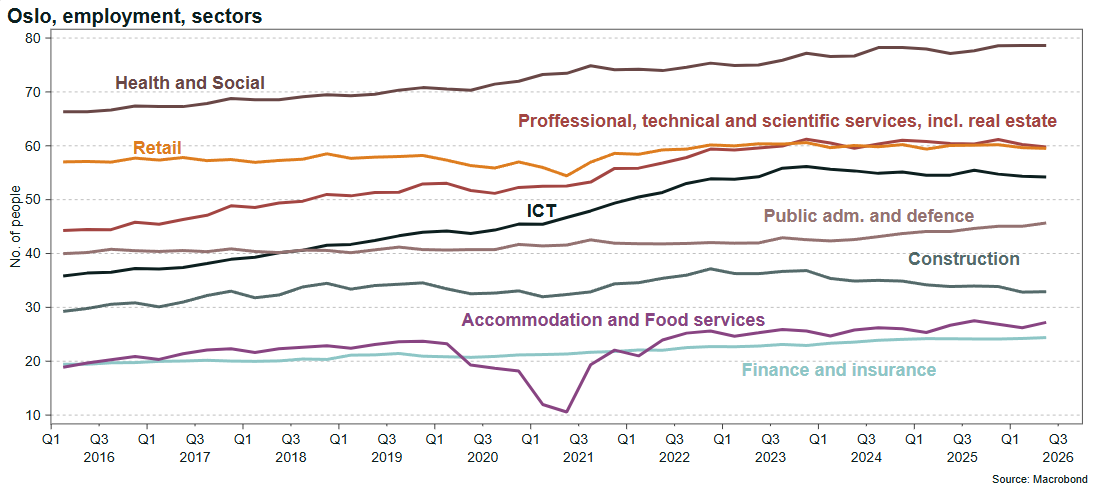
Looking more closely at Oslo, employment in healthcare, public administration and defence, as well as accommodation and food services, has strengthened somewhat over the past three years, whereas most other sectors have experienced flat or declining employment. According to Norges Bank's Regional Network, retailers expect employment growth to weaken in the near term, while the services sector and the construction industry anticipate broadly unchanged staffing levels.
Over the next two years, Norges Bank forecasts a further slowdown in employment growth across the Norwegian economy to an annual rate of around 0.3 percent. This is below the estimated growth rate of the labour force, and the central bank therefore expects unemployment to edge higher.
According to NAV, registered unemployment remains low, including in Oslo. However, Statistics Norway's Labour Force Survey suggests that there is a greater degree of hidden unemployment, including among young adults who are unable to secure employment but do not register as unemployed.
Future Labour Force Growth Will Be More Limited
In the years ahead, Oslo's labour force is likely to expand at a slower pace than it did from the early 2000s until the pandemic. Oslo Municipality projects that the population will increase from approximately 725,000 in 2025 to 831,000 by 2050, representing growth of around 106,000 people. At the same time, the share of the population aged 67 and above is expected to rise from 12 to 18 percent. This implies an increase of roughly 63,000 people in the 67+ age group, while only around 43,000 of the additional 106,000 residents will be below the age of 67.
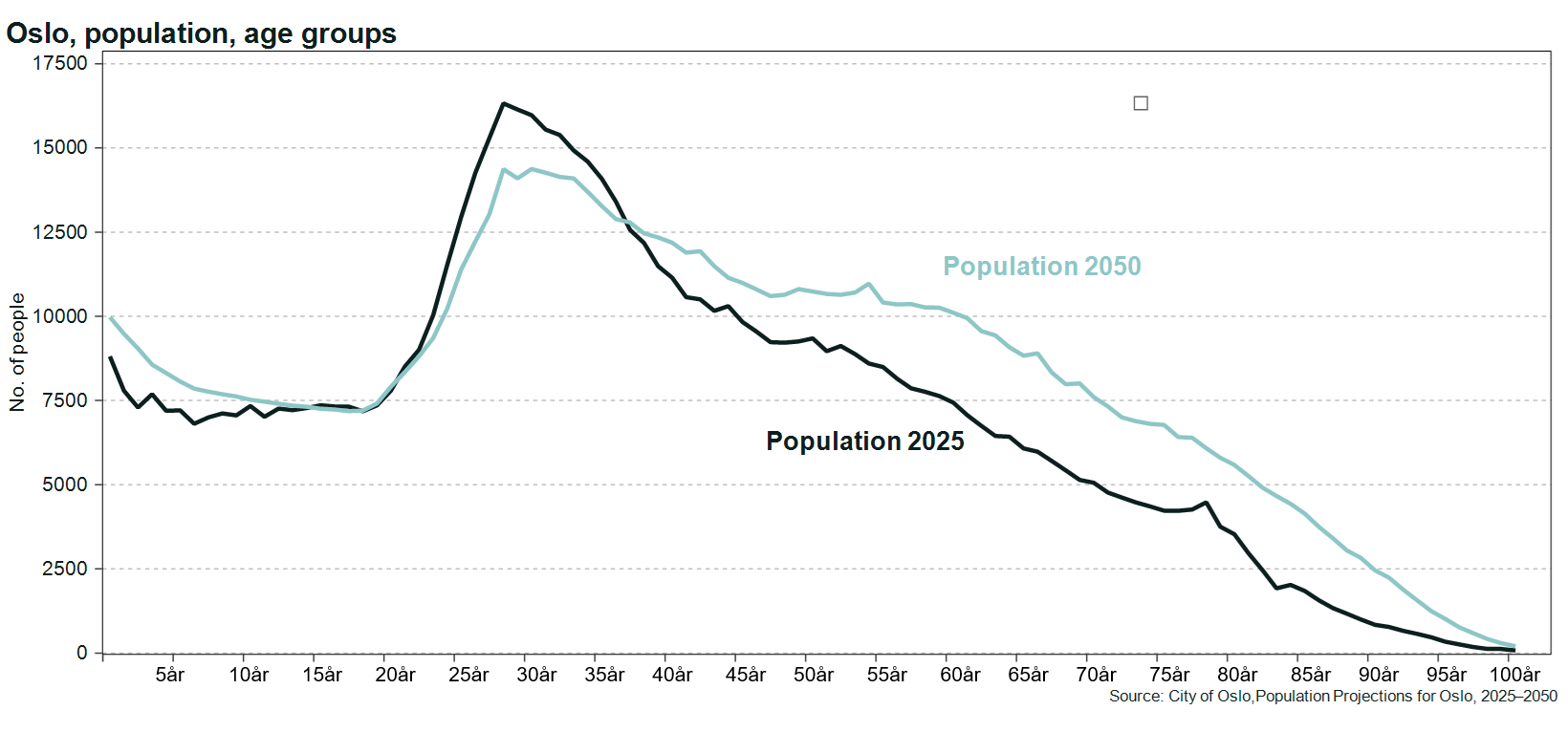
Oslo municipality further estimates that growth in the working-age population will primarily occur among those aged 40-66, while the number of residents aged 19-39 is expected to decline. Applying current labour-force participation rates by age group, as estimated by Statistics Norway, suggests that Oslo's labour force could increase by approximately 32,000-34,000 people by 2050, equivalent to around 1,300-1,400 additional workers per year. If labour-force participation among those aged 67-74 continues to rise, labour-force growth could reach approximately 1,500-2,500 people annually, corresponding to around 0.4-0.5 percent per year. This would still be markedly lower than during 2004-2019, when Oslo's labour force expanded by roughly 7,500 people annually, equivalent to just under 2 percent per year. The expected slowdown in labour-force growth reflects weaker labour immigration, an ageing population, and an assumption of lower net domestic migration into Oslo.
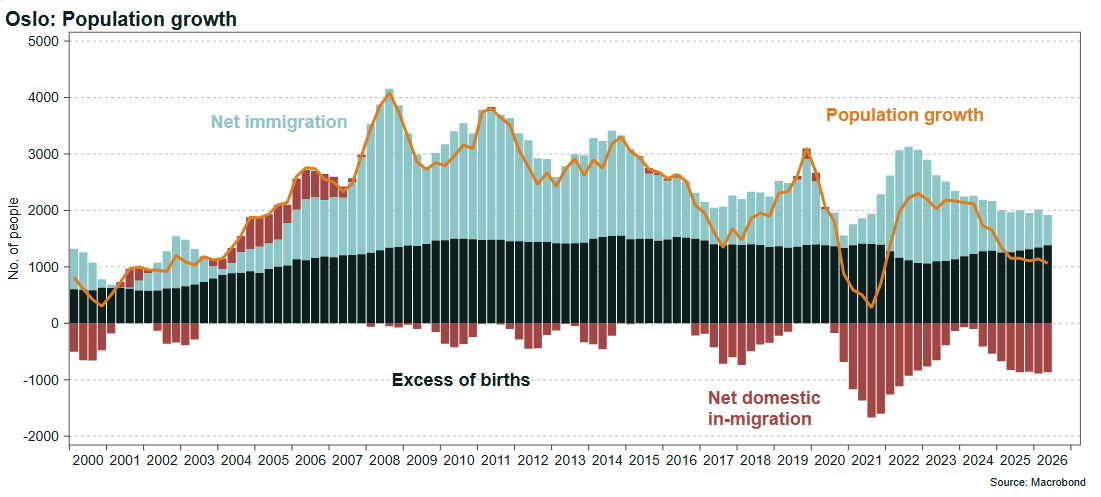
In recent years, Oslo has in fact recorded negative net migration from other regions of Norway, meaning that more people have moved out of the city than have moved in. This trend is expected to continue in the years ahead, partly as a consequence of demographic developments.
Oslo's total population is therefore projected to increase by just over 4,000 people per year, while the labour force is likely to grow by less than half that number. As a result, growth in office-based employment will receive less demographic support than in previous decades, while population ageing is expected to generate stronger demand for jobs in healthcare and social care services.