

Market Views, CRE | Do we have too much office?
Companies continue to reduce their space requirements while prioritising modern office buildings in central locations. The result is rising office vacancy across Oslo, particularly along the eastern fringe, where a significant share of vacancy has become structural rather than cyclical. This growing market bifurcation increases the risk of prolonged vacancy and strengthens the case for converting office buildings that are no longer competitive.
Companies continue to optimise office utilisation
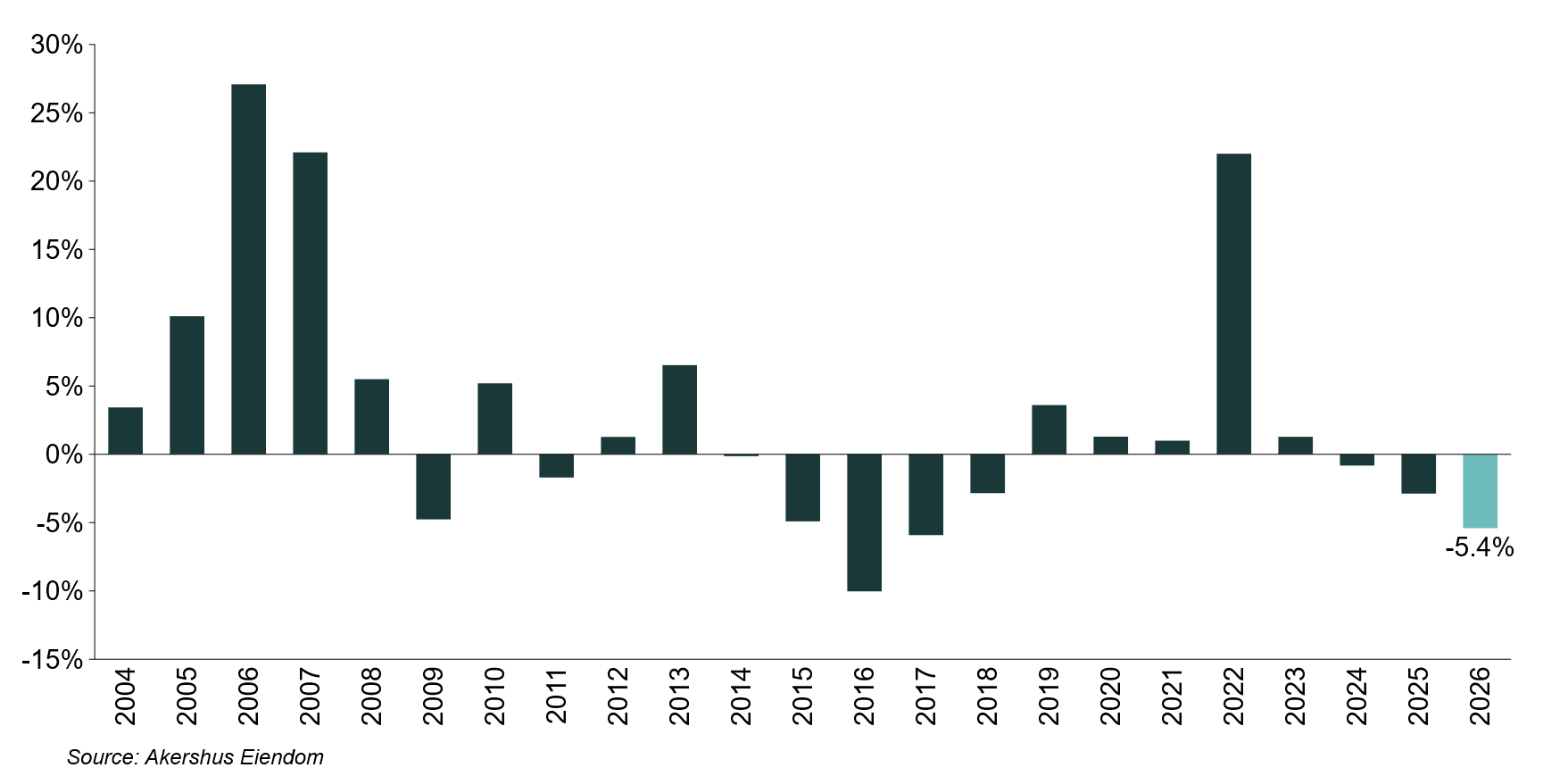
As outlined in the macroeconomic section of this report, Oslo’s labour market has remained subdued in recent years, and uncertainty surrounding future employment growth persists. This has had a clear impact on the office market. This year’s occupier survey shows that office users are, on average, seeking more than 5 percent less space than they currently occupy. It is also the third consecutive year in which companies have reduced their space requirements when relocating or renegotiating existing leases.
Office space requirements survey - development in space requrements
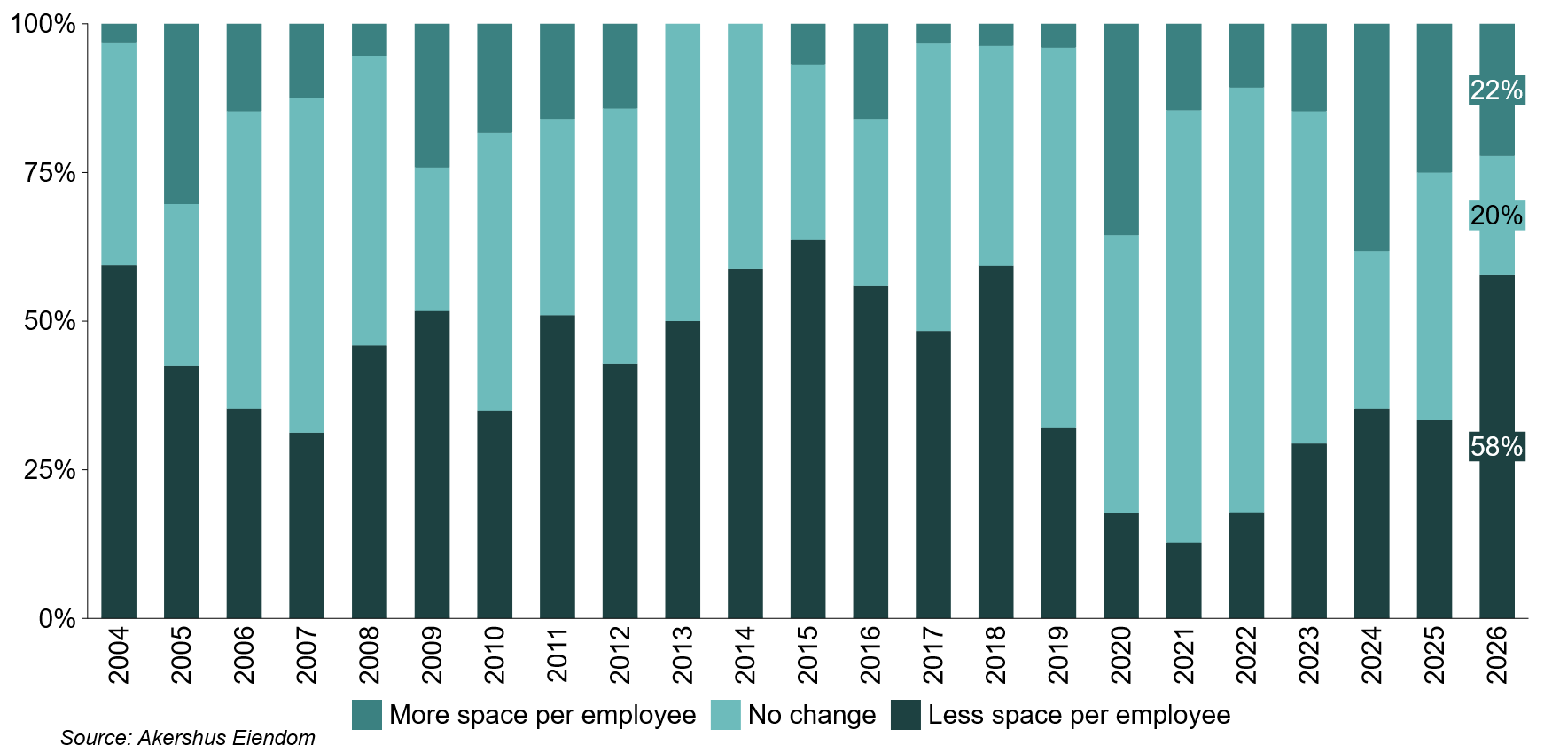
Unlike last year, the trend does not appear to be driven primarily by weaker hiring expectations, but rather by a greater focus on cost efficiency. Several of the companies we have spoken to are, in fact, planning to increase headcount in the coming years. Nevertheless, many of these companies are seeking premises that are smaller than the space they currently occupy. The survey indicates that an increasing number of occupiers intend to improve space efficiency, with nearly 60 percent of respondents expecting to allocate less space per employee going forward.
The trend is particularly pronounced among larger organisations, which typically have greater opportunities to optimise space utilisation through increased desk sharing, fewer assigned workstations and more flexible use of the office. As a result, office layouts are increasingly designed around expected peak occupancy rather than total headcount. Lower space requirements also enable more businesses to prioritise central locations, a trend that is further reflected in current relocation patterns.
Office space requriements survey - development in space efficency
At the same time, more employers want staff back in the office
However, lower workplace occupancy rates and higher levels of space optimisation cannot be explained by remote working alone. Several of the companies we have engaged with are planning significant desk-sharing ratios while still viewing the office as the primary place of work. This aligns with a broader trend of employers seeking increased physical attendance in the workplace.
DNB, one of Norway’s largest employers, has announced that it will phase out fixed remote-working days, while a recent NHO business survey found that 41 percent of business leaders wish to reduce remote working, up from 18 percent two years ago. The findings suggest that attitudes towards home working are changing, while a weaker labour market, both today and in the years ahead, gives employers greater leverage than they have enjoyed in recent years.
We therefore expect more companies to follow DNB’s lead, which could provide some support for office demand. Nevertheless, we believe the trend towards more efficient office utilisation will continue. Meetings, business travel and other activities away from employees’ desks are additional reasons why workstations remain unoccupied for extended periods during the working day, making it possible to reduce the number of desks even with higher levels of office attendance.
Office vacancy continues to rise
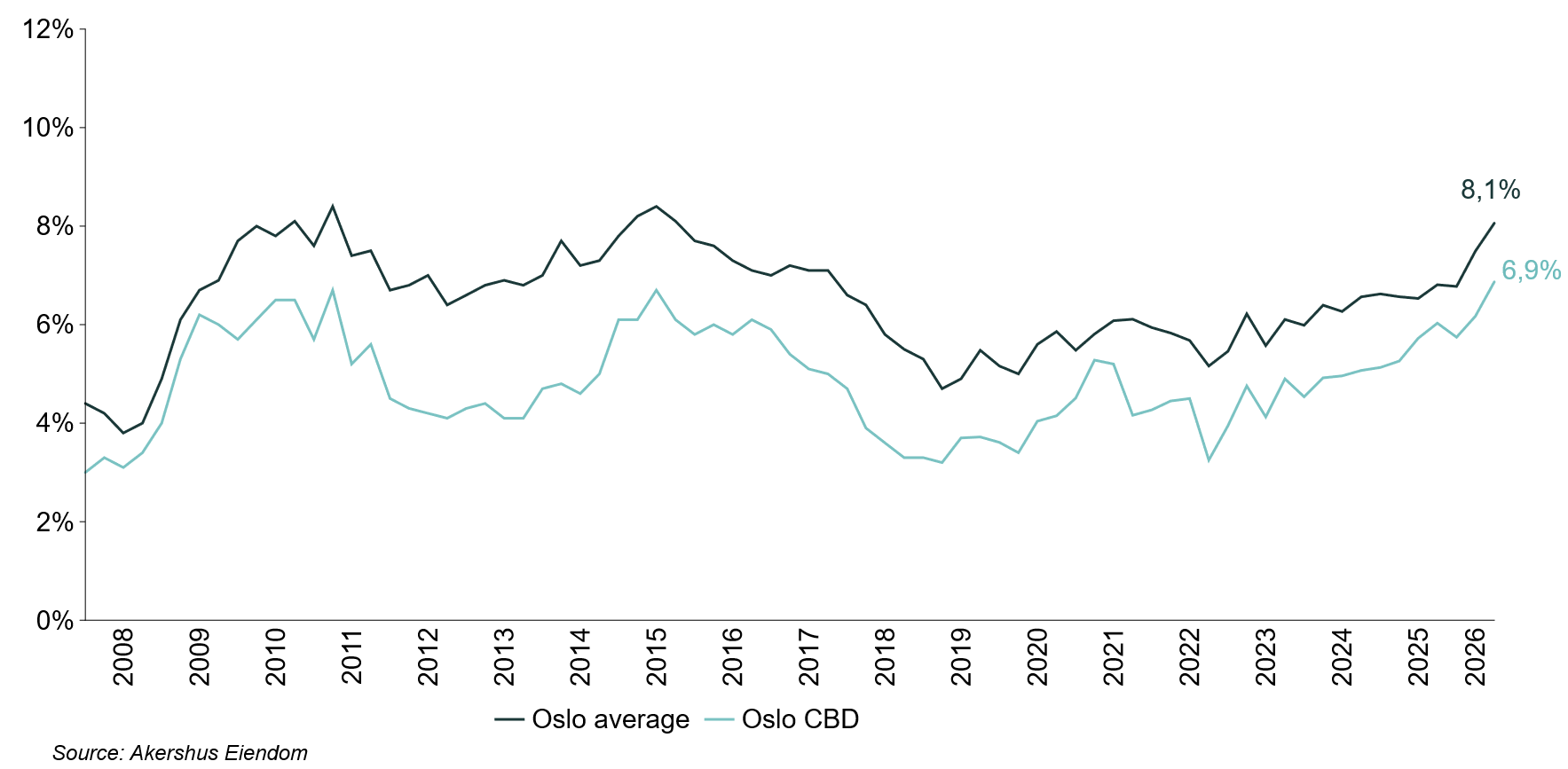
A weaker labour market and increasing space efficiency among occupiers have contributed to higher office vacancy across Oslo over the past year. At the end of the second quarter, we recorded an office vacancy rate of 8.1 percent, well above the post-2010 average of approximately 6.5 percent. Vacancy is also rising in the city centre, where our latest survey indicates a rate approaching 7 percent.
Development in Oslo office vacancy
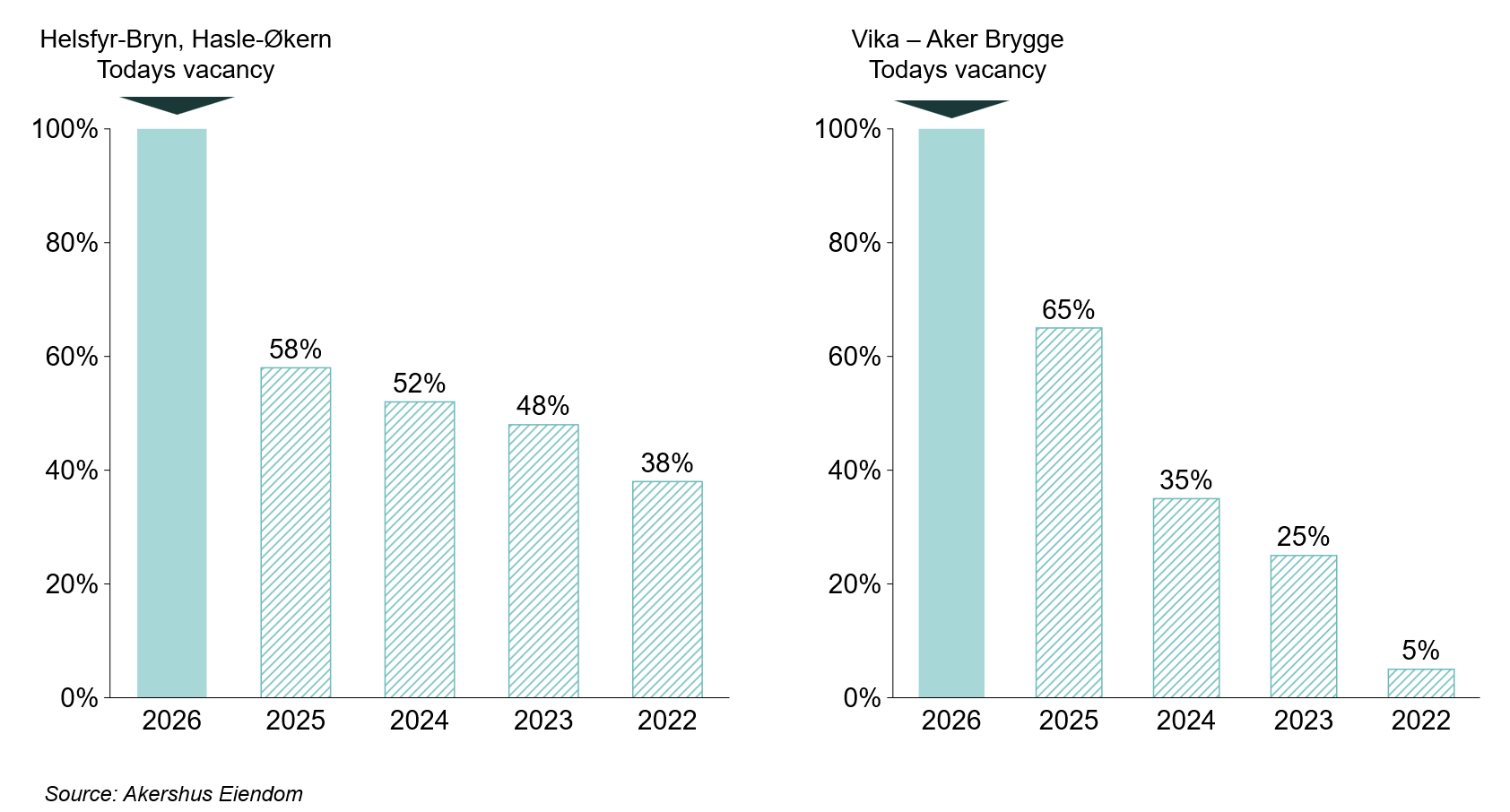
The challenges are, however, significantly greater in the eastern fringe, where office vacancy has reached almost 12 percent according to our measurements. This is the highest level we have recorded since 2007. Weaker demand for office space in the area over recent years has resulted in more vacant buildings and premises remaining empty for extended periods. Within the established office clusters of Helsfyr-Bryn and Hasle-Økern, almost 40 percent of currently vacant space was already vacant in 2022, compared with only 5 percent in Vika-Aker Brygge.
Share of currently vacant office buildings that were also vacant previous years, selected eastern Oslo and CBD submarkets
The difference is also reflected in the quality of the vacant stock. In Helsfyr-Bryn and Hasle-Økern, we estimate that only 30 percent of vacant space can achieve current market rents without substantial upgrades, while 32 percent is located in buildings that should ultimately be considered for conversion to alternative uses. By comparison, 74 percent of vacant space in Vika-Aker Brygge is considered capable of achieving current market rents, and none of the buildings appear to be obvious conversion candidates.
Perceived quality of currently vacant office properties, selected eastern Oslo and CBD submarkets
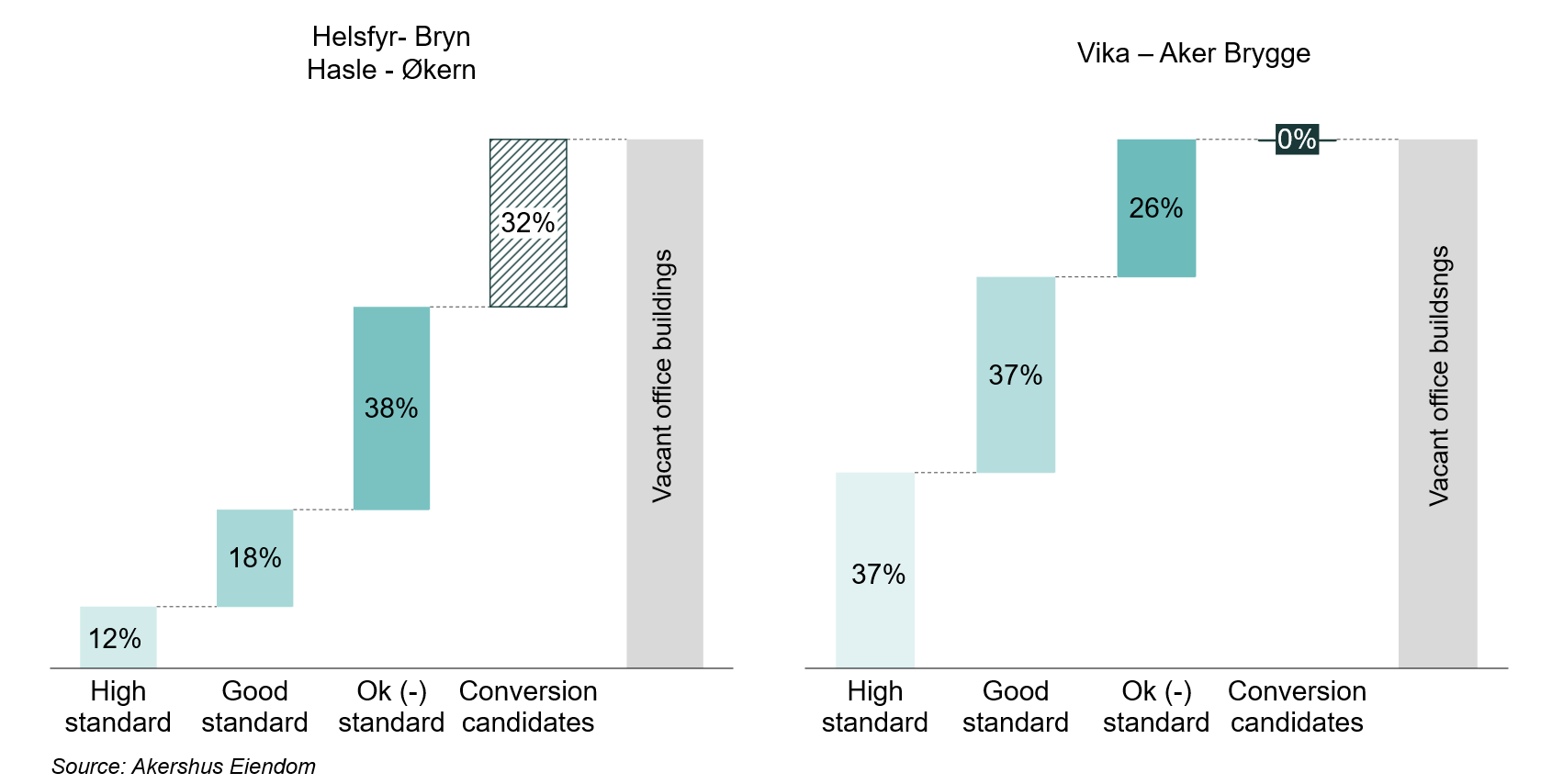
Weak demand in the eastern fringe area is further exacerbated by major occupiers such as Coop and Tine relocating substantial office operations from eastern Oslo to more efficient and central locations. The area must therefore not only absorb existing vacancy but also accommodate an increasing volume of space being released by occupiers already established there. This significantly increases the risk that vacancy will take longer to absorb.
The office market is therefore becoming increasingly bifurcated. In Oslo’s central submarkets, much of the vacant space appears absorbable through normal leasing activity. By contrast, a significant share of the vacancy in the eastern fringe is structural in nature. Many of these premises have remained vacant for several years and no longer meet occupiers’ expectations regarding quality, efficiency and location.
As a result, a considerable proportion of this vacancy is unlikely to be absorbed through conventional leasing. At the same time, relatively low rental levels in the eastern fringe make major refurbishment projects difficult to justify economically due to the required capital expenditure (read more in our November 2025 analysis). Conversion to alternative uses may therefore represent the most viable long-term solution.
Looking ahead, we expect subdued employment growth and continued space optimisation to weigh on overall demand for office space in Oslo. We also anticipate that the ongoing flight-to-quality trend will continue to favour central office locations, while peripheral submarkets with already elevated vacancy levels will remain under pressure. Fortunately, limited new office stock is scheduled for completion in Oslo in the near term. Over the longer term, however, a number of new office developments are planned across several of Oslo’s submarkets. We believe new office schemes will only be delivered where development is economically viable and occupier demand is sufficiently strong, which primarily points to central locations. However, many of the occupiers expected to move into these new city-centre developments are currently located in peripheral submarkets. Their relocation will therefore release additional space and place further upward pressure on vacancy outside the city centre. If the total office stock continues to expand without older and less competitive buildings being withdrawn from the market, we believe vacancy is likely to increase further, with the greatest risk concentrated in the eastern fringe.