

In Short | Downward pressure on logistics yields
The logistics and industrial real estate market has, in recent years, established itself as one of the most attractive segments within commercial real estate. Despite persistently high interest rates, we continue to see strong appetite from a broad investor base and, consequently, rising competition for the best assets. This has contributed to downward pressure on yields, and Akershus Eiendom has therefore adjusted the prime logistics yield indicator down by 25 basis points, from 5.50 to 5.25 percent.
The leasing market for logistics property has remained robust. Vacancy levels have stayed consistently low, while occupier demand has strengthened. We see particularly strong interest in the new-build segment among large, traditional warehouse and logistics operators seeking modern, high-specification and customised facilities. At the same time, we are now observing a slight increase in vacancy in some larger existing buildings, as several occupiers need more time to make decisions or refine their operational concepts. This has contributed to rental levels stabilising at good levels across several of the established parks in and around Oslo.
Several structural drivers, including persistent geopolitical uncertainty, rising trade barriers, and growth in the defence and pharmaceutical industries, support expectations of continued strong activity ahead. Read more about this in our latest analysis of the logistics and industrial market here.
The same dynamics are seen across other European markets. JLL reports increasing demand in the leasing market driven by developments within artificial intelligence, as well as shifts in global trade flows following higher US tariffs on Chinese imports.
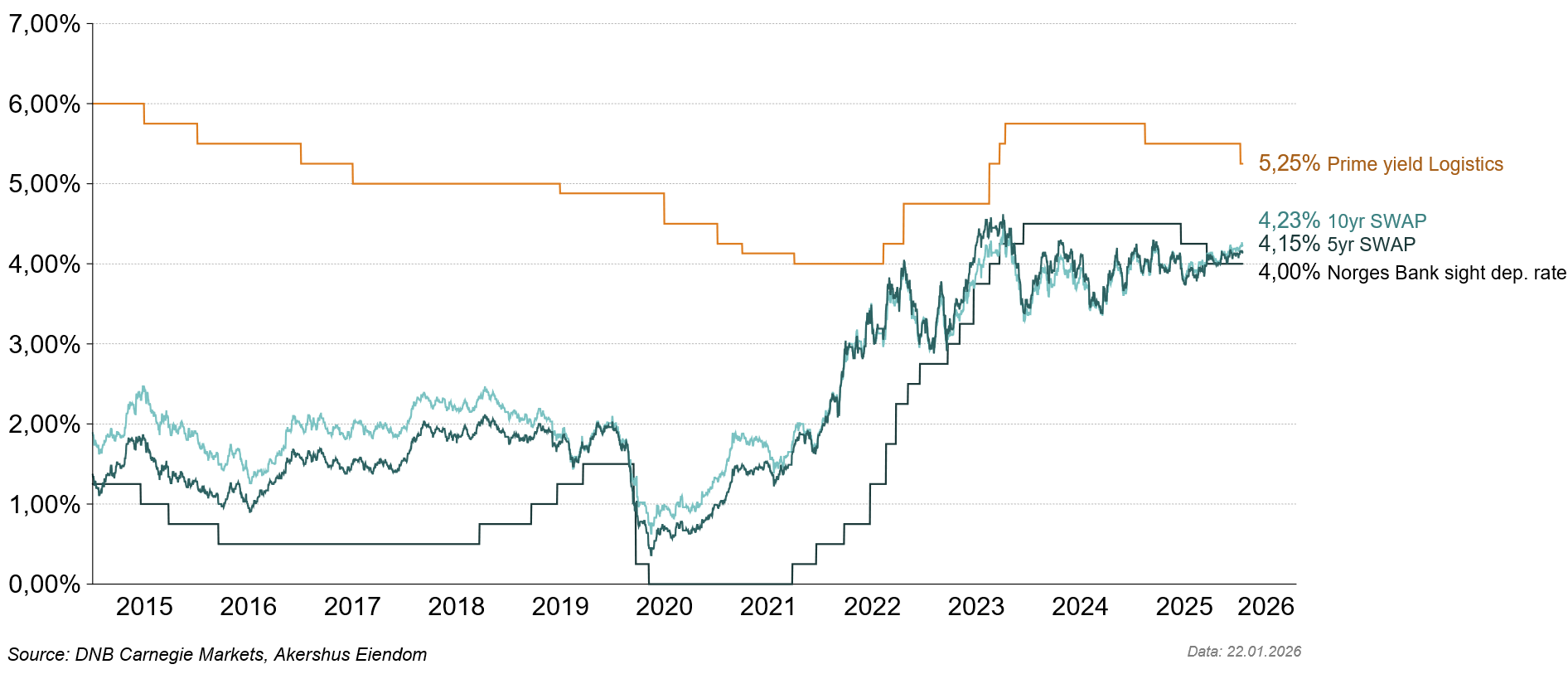
Although transaction volumes improved somewhat in 2025 compared with 2024, the market has remained challenging due to persistently high interest rates and heightened uncertainty. For logistics and industrial properties, the share of total volume was lower than in previous years. This, however, reflects a shortage of assets being brought to market rather than reduced investor interest in the segment.
Domestic pension funds and life-insurance companies have now made a decisive entry into the Norwegian logistics market. Logistics real estate is fully recognised as an institutional product and a natural component of a diversification and portfolio‑optimisation strategy. This has led to increased competition from investors with a low cost of capital and long investment horizons, further contributing to prime yield compression. The transaction in which Bulk Industrial Real Estate sold a stabilised portfolio of 14 assets to KLP Eiendom clearly illustrates this dynamic.
Despite strong demand, market depth at these prime‑yield levels is limited. For leveraged investors, today’s interest-rate environment necessitates higher return requirements to maintain sufficient margin over financing costs and ensure a sustainable yield spread and risk‑adjusted return.